

 Language
Laboratory electronic balances are core precision weighing instruments for scientific research and experimental analysis. Replacing traditional mechanical scales, they deliver fast, accurate digital mass readings, supporting rigorous measurement tasks in chemistry, biology, and material science laboratories.
Laboratory electronic balances have revolutionized precision weighing workflows in modern scientific laboratories, offering remarkable advantages over conventional mechanical weighing devices. Unlike mechanical balances that rely on manual weight comparison and lever balance structures, electronic models adopt advanced electrical sensing and signal processing technologies to achieve automated and intelligent weighing. These instruments are designed to capture tiny mass changes with high sensitivity, eliminating the human errors that frequently occur in manual reading and operation. Their stable performance and intuitive digital display make them indispensable basic equipment for all kinds of quantitative experimental operations, laying a solid foundation for reliable experimental data acquisition in scientific research.
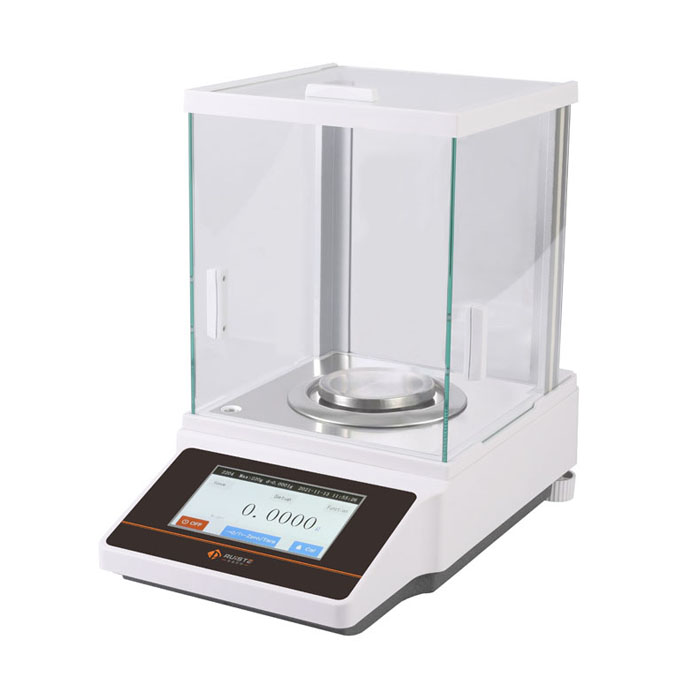
The core working principle of laboratory electronic balances mainly relies on electromagnetic force compensation technology, which is the key to their high-precision measurement capability. When a sample or container is placed on the weighing pan, the gravity of the object causes a slight displacement of the pan structure. The internal electromagnetic coil immediately generates a reverse electromagnetic force to offset the downward gravity and restore the weighing pan to its original balanced position. The current required to maintain this force balance is in direct proportion to the mass of the measured object. The built-in microprocessor converts the collected current signal into accurate digital mass data after amplification, analog-to-digital conversion and algorithm calculation, and finally presents the reading on the high-definition display screen in real time.
A complete laboratory electronic balance consists of multiple sophisticated functional components that cooperate to ensure stable and precise operation. The weighing pan, usually made of corrosion-resistant metal materials, undertakes the bearing work of measured samples and adapts to various solid and liquid sample weighing scenarios. The high-sensitivity sensing system captures subtle pressure changes and converts physical signals into electrical signals. Equipped with a professional data processing chip, the instrument can quickly analyze and optimize signal data to avoid data deviation caused by signal interference. In addition, the built-in self-checking module and temperature compensation structure can automatically adjust internal parameters according to ambient changes, further improving the stability and accuracy of measurement results in complex laboratory environments.
Standardized pre-operation preparation is essential to ensure the long-term stable operation and accurate measurement of electronic balances. Before starting the weighing work, users need to place the instrument on a horizontal, stable and vibration-free experimental platform to avoid measurement errors caused by tilt or external shaking. It is necessary to turn on the power in advance for a period of preheating, which can fully activate the internal circuit system and make the sensor and chip reach the optimal working state. Meanwhile, the weighing pan and the surrounding protective windshield should be cleaned thoroughly to remove residual dust, sample residues and sundries, preventing foreign substances from affecting the weighing accuracy. After preheating, the automatic zero-setting function is started to calibrate the initial state of the instrument.
Standard weighing operation specifications determine the authenticity and repeatability of experimental data obtained by electronic balances. In formal measurement, users can place a clean and dry weighing container or weighing paper on the pan first, and press the tare button to eliminate the mass of the container, realizing zero-baseline measurement. Samples should be added slowly and gently to avoid splashing or impacting the weighing pan, which may cause instantaneous signal fluctuation and data deviation. For volatile or easily contaminated samples, closed containers are required for weighing to prevent sample loss and environmental interference. After the data reading stabilizes, users should record the numerical value in time and avoid touching the experimental platform or instrument body during the measurement process.
Reasonable environmental control is crucial to maintain the measurement performance of laboratory electronic balances for a long time. These precision instruments are sensitive to ambient temperature, humidity, airflow and electromagnetic interference. Excessively high or low temperature will affect the sensitivity of internal sensors and the stability of circuit operation, while excessive humidity may cause dampness of internal electronic components and even cause short-circuit faults. Strong airflow generated by air conditioners and windows will interfere with the stress balance of the weighing pan, resulting in floating data. In addition, electronic equipment such as ovens and stirrers placed nearby will produce electromagnetic radiation, which will disturb signal transmission and reduce measurement precision.
Daily maintenance and scientific maintenance can effectively extend the service life of laboratory electronic balances and maintain their optimal working performance. After each use, users need to clean the weighing pan and the instrument surface in time, wipe off sample residues and stains with soft cleaning tools, and keep the instrument in a dry and clean state. It is not allowed to place overloaded samples on the weighing pan for measurement for a long time, so as to avoid permanent deformation of the sensing structure and attenuation of sensitivity. The instrument should be placed in a dry and dust-proof storage environment when not in use for a long time, and regular power-on self-checks should be carried out to ensure the normal operation of internal functional modules.
Laboratory electronic balances cover a wide range of application scenarios, fully meeting the precision measurement needs of multiple scientific research fields. In chemical experiments, they are used for accurate weighing of chemical reagents, drug raw materials and experimental samples, ensuring the accurate proportioning of experimental formulas and the repeatability of chemical reactions. In biological laboratories, the instruments are applied to the weighing of biological samples, culture medium configurations and microbial experimental materials, providing accurate data support for biological analysis and experimental research. In material science and environmental detection experiments, they can complete the precise measurement of micro samples and trace substances, supporting high-precision experimental analysis and data research.
Modern laboratory electronic balances are continuously optimized in functional design to adapt to diversified experimental needs. Most instruments are equipped with intelligent tare clearing, automatic zero tracking and data locking functions, which effectively solve the problems of baseline drift and unstable reading in the weighing process. The high-definition digital display system can clearly present accurate numerical values, and some models support real-time data transmission, which is convenient for users to record, sort out and analyze experimental data. The optimized mechanical structure design reduces the influence of external vibration and subtle interference, enabling the instrument to maintain stable measurement performance in conventional laboratory working environments.
In experimental research involving repeated measurement and batch sampling, the stability and consistency of electronic balances are particularly prominent. Compared with traditional manual weighing methods, electronic weighing equipment avoids subjective reading errors and operation deviations, and the measurement data has higher consistency and reproducibility. This feature is very important for comparative experiments, controlled experiments and batch sample detection, which can effectively reduce experimental data errors, improve the credibility of experimental results, and provide reliable basic data for subsequent experimental analysis, result verification and academic research.
As an essential precision experimental device, laboratory electronic balances play an irreplaceable basic role in modern scientific research and laboratory testing work. Their high precision, convenient operation, stable performance and intelligent functions greatly optimize the experimental weighing process, improve the efficiency and accuracy of quantitative experiments. With the continuous development of laboratory testing technology, electronic balance technology is also constantly upgraded, providing more accurate, efficient and reliable measurement support for innovative research and routine testing in various scientific fields.
Pruiste supply precision balance,analytical balance,laboratory balance,moisture analyzer,digital viscometer,weighing scale,counting scale for sale, wholesale and custom fabrication. we are a professional manufacturer and supplier of electronic balance in china.
 Chinese Mobile
 Whatsapp Service
 WeChat Service


